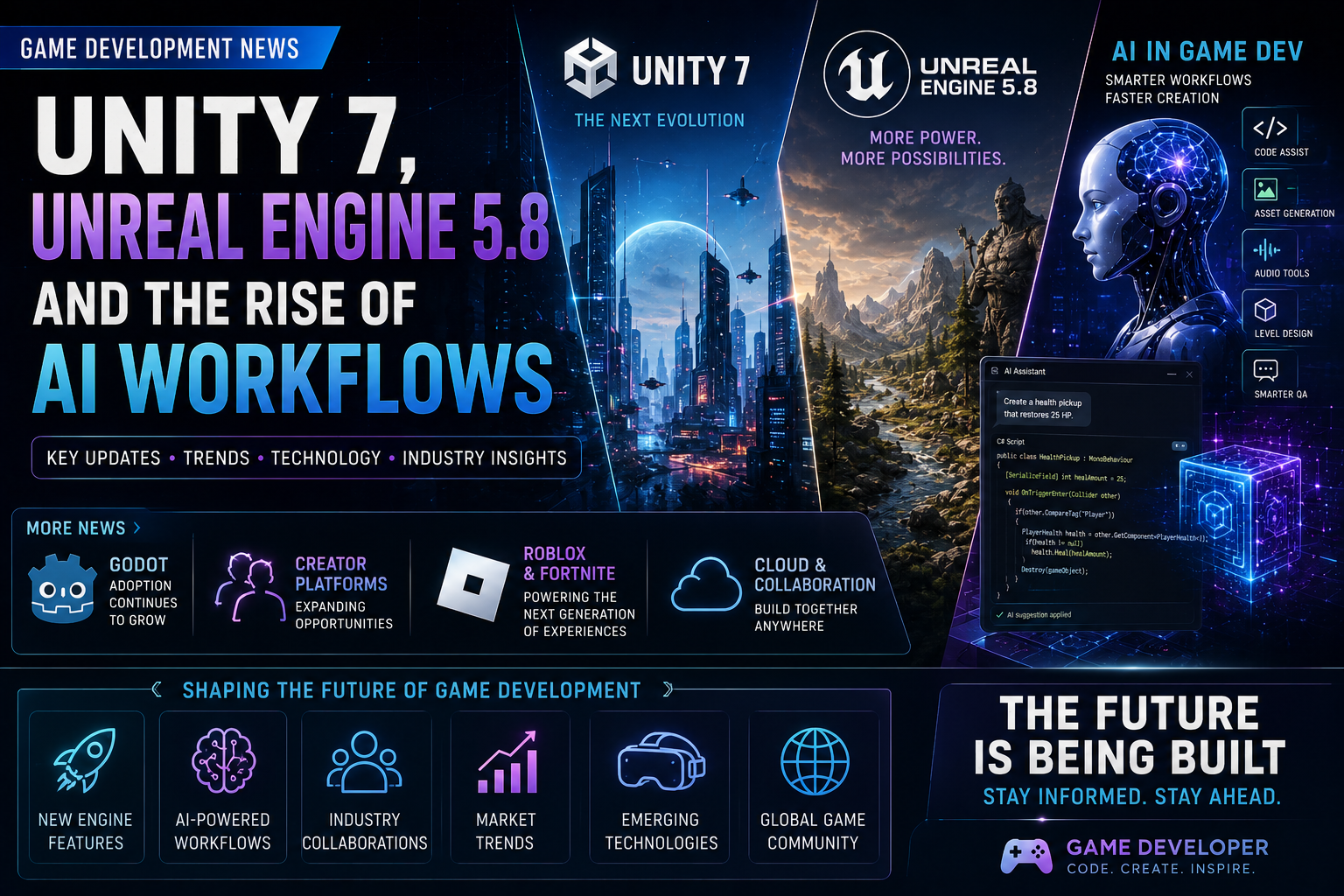
The game development industry continues to change quickly in 2026.
Game engines are becoming more powerful, AI is becoming part of development workflows, and developers are increasingly looking beyond traditional PC and console distribution.
Here are some of the biggest developments developers should be watching.
Unity 7 Is on the Horizon
Unity announced its Unity 7 roadmap at Unite Seoul in July 2026.
According to Unity, Unity 7 is designed around collaboration between developers, artists, producers, and coding agents. Unity also says the transition from Unity 6 is designed without the traditional breaking upgrade experience.
One particularly interesting direction is the integration of AI-assisted development into the broader production workflow.
For Unity developers, this could mean more automation across:
- Coding
- Production
- Asset workflows
- Testing
- Deployment
- Collaboration
Unity and Unreal Are Getting More Connected
One of the more surprising developments is Unity’s work with Epic around running Unity technology inside Unreal Engine environments.
Unity has described this as a concrete milestone in its partnership with Epic.
If this technology develops as planned, it could eventually give studios more flexibility when combining technologies from both ecosystems.
For developers who traditionally viewed Unity and Unreal as competing ecosystems, this is an interesting change.
Unreal Engine 5.8 Arrives
Epic released Unreal Engine 5.8 with improvements across worldbuilding, terrain, vegetation, animation, lighting, performance, and content creation.
The update also includes advances in AI-assisted content creation and development workflows.
Epic has also said that UE5.8 is the last planned major Unreal Engine 5 release on its current roadmap as development moves toward Unreal Engine 6.
AI Is Becoming Part of Game Development
AI is no longer limited to experimental prototypes.
Developers are increasingly using AI for:
- Programming assistance
- Concept development
- Technical documentation
- Prototyping
- Asset workflows
- Testing
- Automation
But the industry is also debating how much AI-generated content should be used in commercial games.
The important question isn’t simply:
“Can AI make this?”
It’s:
“Does using AI make the development process better?”
Human creativity, design decisions, art direction, programming architecture, and gameplay design remain extremely important.
Godot Continues to Gain Attention
Godot continues to attract developers who value its open-source nature and lightweight workflow.
Recent reporting from Game Developer highlights increasing adoption and developer interest in Godot, with developers citing its lightweight nature as one of the reasons for choosing it.
For indie developers, the growing engine ecosystem is good news.
Developers now have more choices than ever:
- Unity
- Unreal Engine
- Godot
- GameMaker
- Cocos
- Custom engines
Creator Platforms Are Becoming More Important
Game development is also expanding beyond traditional storefronts.
Platforms such as Roblox and Fortnite increasingly provide developers with tools for creating interactive experiences inside large existing ecosystems.
A recent example is Mattel launching Mattel Game Studios with a significant focus on platforms such as Roblox and Fortnite.
This reflects a broader industry trend:
The game is becoming a platform, not just a product.
What Does This Mean for Developers?
For individual developers, the industry changes create both opportunities and challenges.
The most valuable skills increasingly extend beyond simply knowing an engine.
Developers should consider learning:
Programming + Game Engine + Art Pipeline + AI Tools + Optimization + Publishing
For example, a Unity developer who understands C#, Blender, shaders, networking, AI-assisted development, and mobile optimization can potentially contribute to a much wider range of projects.
The Future of Game Development
The next generation of game development will probably not be defined by a single engine.
Instead, developers will work across interconnected tools and platforms.
We are already seeing:
- AI-assisted development
- More powerful procedural tools
- Cross-engine technology
- Cloud collaboration
- Creator platforms
- Open-source engines
- Automated workflows
For developers, this means the ability to learn, adapt, and combine technologies may become just as important as mastering a specific engine.
Final Thoughts
Game development is entering an interesting period.
Unity is preparing Unity 7, Unreal Engine is moving toward UE6, Godot continues to grow, AI is becoming part of development workflows, and creator platforms are expanding the definition of what a game can be.
For developers, the best strategy is not to chase every new technology.
Instead, build strong fundamentals and learn new tools when they provide a genuine advantage.
Build. Experiment. Learn. Ship.