Game development sits at the intersection of technology, creativity, design, and problem-solving.
For me, that’s what makes it so interesting.
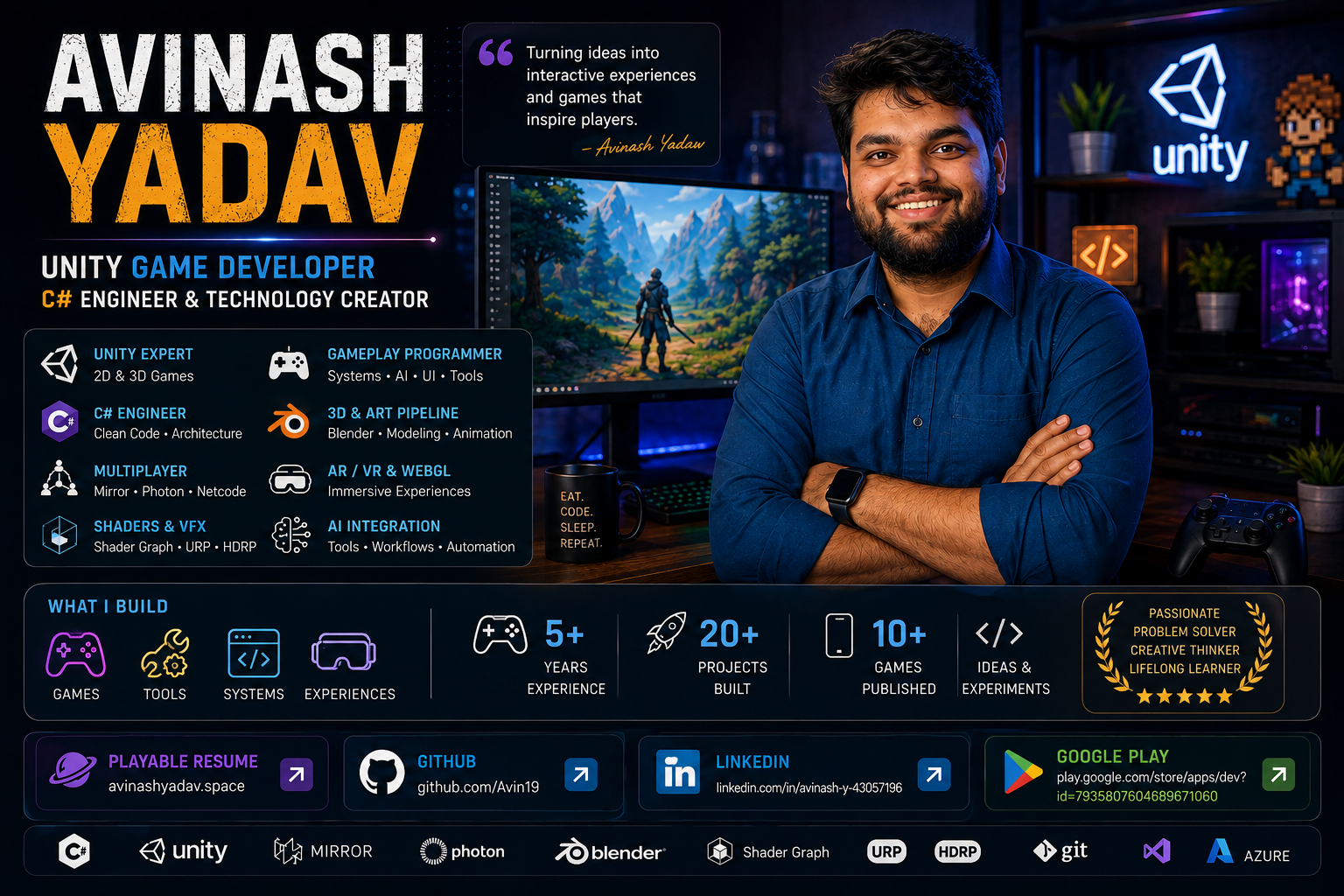
I’m Avinash Yadav, a game developer and software engineer focused primarily on Unity and C#, with experience exploring multiplayer games, shaders, VFX, 3D development, AI, AR/VR, backend technologies, and interactive applications.
Over the years, I’ve worked on games, prototypes, tools, experiments, educational projects, and published Android applications.
I created GameDevloper to document that journey and share practical knowledge with other developers.
🎮 My Approach to Game Development
I’ve always believed that the best way to learn technology is to build something with it.
Reading documentation and watching tutorials can teach you the fundamentals, but building an actual game introduces problems that tutorials can’t always prepare you for.
You have to deal with:
- Performance
- Architecture
- Bugs
- Memory management
- User experience
- Art pipelines
- Animation
- Networking
- Deployment
- Monetization
- Platform limitations
And that’s where the real learning happens.
My development philosophy is simple:
Build → Break → Learn → Improve → Ship
Every project provides another opportunity to understand something better.
🧑💻 Unity & C#
Unity has been at the center of my game-development journey.
I enjoy working on both gameplay and the underlying systems that make a project scalable and maintainable.
My Unity experience includes areas such as:
- Unity 2D and 3D
- C#
- Gameplay programming
- UI systems
- Animation
- Timeline
- Cinemachine
- Shader Graph
- URP/HDRP
- VFX
- Optimization
- AssetBundles
- Addressables
- WebGL
- Multiplayer networking
I particularly enjoy solving technical problems where multiple systems need to work together.
For example:
Gameplay
    ↓
Game Systems
    ↓
UI / Animation
    ↓
Networking
    ↓
Assets
    ↓
Optimization
    ↓
Deployment
Understanding how these pieces interact is what turns a prototype into a real product.
💻 C# & Software Architecture
Game development isn’t just about knowing Unity APIs.
As projects become larger, software architecture becomes increasingly important.
I’ve worked with concepts such as:
- Object-oriented programming
- SOLID principles
- Design patterns
- Events and delegates
- Generics
- Interfaces
- Dependency injection
- MVC-style architecture
- State machines
- Factory patterns
- Observer patterns
- Object pooling
A small prototype can survive with a few scripts.
A production game eventually needs a structure that allows multiple systems and developers to work without everything becoming tightly coupled.
That’s why I’m particularly interested in clean, reusable, and maintainable game systems.
🌐 Multiplayer Game Development
Multiplayer development adds another layer of complexity to game development.
A local game can often rely on a single source of truth.
A multiplayer game needs to deal with:
Player A
   ↓
Network
   ↓
Server / Host
   ↓
Network
   ↓
Player B
I’ve explored multiplayer development using technologies including:
- Mirror
- Photon PUN
- Unity networking technologies
I’ve worked with concepts such as:
- Network synchronization
- Networked player movement
- RPCs
- Authority
- Multiplayer gameplay
- Network optimization
Multiplayer development has taught me that good architecture becomes even more important when systems have to operate across a network.
🎨 Game Art & 3D Development
Although programming is a major part of my work, I’m also interested in the visual side of game development.
I’ve explored:
- Blender
- 3D modelling
- Pixel art
- Game environments
- VFX
- Shaders
- Materials
- Animation
- Photogrammetry
One of the advantages of understanding both programming and art pipelines is being able to communicate more effectively across the entire development process.
A technical artist, programmer, and designer don’t necessarily need to do the same work—but understanding each other’s problems makes collaboration much easier.
✨ Shaders, VFX & Rendering
Rendering technology is another area I enjoy experimenting with.
I’ve worked with technologies such as:
- Shader Graph
- URP
- HDRP
- Custom shaders
- Particle systems
- VFX
- Materials
- Lighting
Shaders are particularly interesting because relatively small pieces of code can completely change the appearance of a game.
Effects such as:
- Dissolution
- Holograms
- Water
- Outlines
- Energy effects
- Distortion
- Neon materials
can significantly change the visual identity of a game.
🤖 AI & Game Development
AI is becoming one of the most interesting technologies for game developers.
I’m particularly interested in how AI can help developers improve their workflows rather than simply trying to automate everything.
AI can assist with:
- Coding
- Debugging
- Game design
- NPC behaviour
- Procedural content
- Dialogue
- Testing
- Game art
- Prototyping
- Documentation
- Development tools
A useful way to think about AI is as a development multiplier.
The developer still needs to understand the technology and make the final decisions, but AI can reduce the time spent on repetitive work.
🌍 AR, VR & Interactive Technology
My interests also extend beyond traditional games.
I’ve explored:
- AR
- VR
- WebGL
- Web-based interactive experiences
- 3D visualization
- Photogrammetry
- Interactive applications
These technologies demonstrate how game engines can be used for much more than games.
A modern game engine can become a platform for:
Games + Simulation + Education + Visualization + Training + Interactive Experiences
☁️ Beyond Game Development
While Unity is my primary game-development environment, I’ve also worked with technologies outside the game-engine ecosystem.
My broader technical interests include:
Backend & Cloud
- .NET
- C#
- SQL
- Azure
- Azure Functions
- MongoDB
Programming
- C#
- Python
- JavaScript/web technologies
AI
- AI-assisted development
- AI integrations
- Machine-learning concepts
- Generative AI workflows
This broader software-engineering experience helps me approach games as complete software products.
🔧 Hardware & IoT Experiments
I also enjoy experimenting with electronics and connected devices.
I’ve worked with platforms such as:
- ESP32
- ESP8266
- NodeMCU
- Arduino-compatible boards
and hardware including:
- OLED displays
- LED matrices
- TFT displays
- Sensors
- LEDs
These projects have included connected displays, sensors, web interfaces, and small IoT experiments.
The interesting part is combining hardware and software into something interactive.
🎮 Games I’ve Built & Published
One of the most important parts of my journey has been turning ideas into playable experiences.
I’ve worked on projects spanning different genres and technologies, including:
- Action games
- Puzzle games
- Multiplayer games
- Shooters
- Strategy systems
- Horror experiences
- Educational games
- Experimental prototypes
I’ve also published Android games through MbitStudio.
You can explore my published games through my Google Play developer profile:
View my Google Play Developer Profile
Some of the published projects include games such as:
- Echo Void: Sound Puzzle
- Color Shift: Neon Assault
- Math Logic IQ
- Kite Clash
- Arrow Out
- NoNoGram
- PipeLink
- Logo Quiz
Publishing a game is a very different experience from simply building a prototype.
You have to think about:
Development → Testing → Store Listing → Monetization → Updates → Analytics → User Experience
That complete lifecycle is an important part of being a game developer.
🕹️ My Playable Resume
Traditional resumes are useful, but game developers have another option:
Make the resume interactive.
I’ve built a playable/interactive resume that allows visitors to explore my experience and work in a format closer to the medium I work in.
🎮 Explore my playable resume:
The project combines my interests in:
- Unity
- Interactive design
- Game development
- Web technologies
- 3D
- Creative presentation
It’s also an experiment in asking:
What if a developer’s portfolio could feel more like an experience than a document?
💻 My GitHub
I also share development work, experiments, and code through GitHub.
GitHub is where I can document the technical side of projects through:
- Source code
- Experiments
- Unity projects
- Tools
- Prototypes
- Programming examples
For developers, seeing the actual implementation can often be more useful than simply reading a list of technologies.
💼 Connect With Me on LinkedIn
For my professional experience and career background, you can find me on LinkedIn.
I use LinkedIn to share professional updates, development work, technology interests, and career-related content.
🧪 Why I Keep Building Experiments
Not every project needs to become a commercial game.
Some projects exist simply to answer a question.
For example:
Can this shader effect work?
Can this multiplayer system scale?
Can this hardware communicate with Unity?
Can AI speed up this workflow?
Can a resume become an interactive experience?
These experiments often lead to unexpected ideas.
That’s why I believe developers should continue experimenting even when a project doesn’t become a finished product.
📚 Why I Created GameDevloper
GameDevloper is an extension of that philosophy.
The goal isn’t simply to publish generic lists of programming tips.
I want the website to focus on practical game-development knowledge.
The main areas include:
🎮 Game Development
Game design, programming, optimization, architecture, workflows, and development techniques.
🧩 Unity
Unity tutorials, systems, performance optimization, tools, rendering, networking, and practical development guides.
💻 C#
C# programming, OOP, design patterns, architecture, and techniques useful for game developers.
🤖 AI for Game Development
AI tools, workflows, NPC systems, procedural content, and AI-assisted development.
🎨 Game Art
Pixel art, Blender, 3D modelling, shaders, VFX, UI, animation, and asset pipelines.
🛠️ GameDev Tools
Developer tools, plugins, workflows, asset pipelines, software, and services that can improve productivity.
📰 Game Development News
Engine updates, development tools, industry changes, releases, and important developments affecting developers.
🎯 What I Want to Share
The game-development ecosystem changes quickly.
New versions of engines arrive.
New AI tools appear.
New rendering techniques become available.
New development workflows emerge.
Rather than trying to know everything, I prefer to learn, experiment, build, and share the results.
That’s the philosophy behind the content on GameDevloper.
🚀 What’s Next?
My interests continue to evolve around the intersection of:
Game Development + AI + Software Engineering + 3D + Interactive Technology
I’m particularly interested in what happens when traditional game-development workflows are combined with newer technologies.
For example:
Unity
  +
C#
  +
AI
  +
Cloud
  +
3D
  +
Interactive Technology
The possibilities are enormous.
And we’re still very early in understanding what developers can build when these technologies start working together.
🎮 Explore My Work
If you’ve reached this point, here are the places where you can explore my work in more detail:
🎮 Playable Resume
Explore my experience and projects through an interactive format.
💻 GitHub
Explore source code, projects, experiments, and development work.
View my professional experience and career journey.
📱 Google Play
View My Published Android Games
Explore games I’ve published on Android.
Final Thoughts
Game development has taught me that technology is only one part of creating something great.
You need:
Technical skills + creativity + persistence + experimentation
There will always be bugs.
There will always be another technology to learn.
There will always be another system that needs optimization.
And there will always be another game idea.
That’s what makes development exciting.
I’m continuing to learn, build, experiment, and share what I discover along the way.
Welcome to GameDevloper.
Build. Experiment. Learn. Ship. 🎮